



How long should a pair of cycling bib shorts last?
One year?
Two years?
5,000 miles?
10,000 miles?
There is a problem with all of those answers:
cycling bib shorts do not wear out according to the calendar.
A rider using the same bib four times every week is putting very different demands on it from someone who rides twice a month.
Ride duration matters.
Sweat matters.
Washing matters.
Fabric matters.
The chamois matters.
And how many bibs you rotate through matters.
PEARL iZUMi's current chamois guidance does not give one universal replacement mileage. Instead, it says chamois life depends on ride frequency, care and mileage, and recommends replacement when the pad feels compressed, shifts out of place or no longer provides the support it once did.
That gives us a better way to think about cycling bib value.
Instead of asking only:
How much did these bib shorts cost?
ask:
How many good rides did I actually get from them?
That turns a $40 bib from simply being a “budget purchase” into something much more useful:
a cost-per-ride decision.
There Is No Universal Lifespan for Cycling Bib Shorts
The simplest answer to “how long should bib shorts last?” is:
until the important parts stop doing their job.
That can happen at very different times for different riders.
PEARL iZUMi specifically says chamois lifespan depends on ride frequency, care and mileage, rather than setting one universal replacement interval. The brand recommends replacing the garment when the pad becomes compressed, starts shifting or stops providing its original level of support.
That makes more sense than choosing an arbitrary rule such as:
“replace every 12 months.”
Consider two cyclists.
Rider A rides four times per week and uses one favorite bib constantly.
Rider B rides once per week and rotates between three pairs.
Even if they bought their bibs on the same day, those garments are not accumulating the same number of:
pedaling cycles,
sweat exposure,
wash cycles,
or saddle-contact hours.
So age alone tells us very little.
A better lifespan question is:
Is the bib still delivering the performance I bought it for?
For a cycling bib, that means looking beyond appearance.
A pair can still look black and relatively clean while the chamois or stretch recovery is no longer behaving the way it did when new.
How Do You Know When Cycling Bib Shorts Need Replacing?
The strongest replacement signs are functional.
Not cosmetic.
A small amount of pilling or a faded logo does not necessarily mean a bib has stopped working.
The more important question is whether the parts that affect the ride are degrading.
The chamois no longer supports you like it used to
This is one of the clearest signs.
PEARL iZUMi recommends considering replacement when the chamois feels permanently compressed or no longer provides adequate support.
You may notice that a bib which once worked comfortably for two or three hours now becomes noticeable much earlier.
That does not automatically prove the foam has failed—saddle setup, riding position and fitness can also change—but declining pad performance is worth checking.
The chamois starts moving more than before
If a bib previously held its pad securely but now the chamois begins shifting, the problem may no longer be only sizing.
The surrounding material may have lost some of the tension that previously helped stabilize it.
PEARL iZUMi lists pad shifting as another practical sign that a chamois or garment may be reaching replacement time.
Why does your chamois move while riding?
The garment no longer holds the same fit
Bib shorts depend on elastane and other stretch fibers to keep the garment close to the body.
If the shorts begin feeling looser through the:
hips,
thighs,
leg openings,
or straps,
the fit system may no longer work as it originally did.
This matters because, as we established in BLOG #10, pad stability depends on the whole garment rather than the chamois alone.
Seams, grippers or straps stop functioning correctly
A small cosmetic change is one thing.
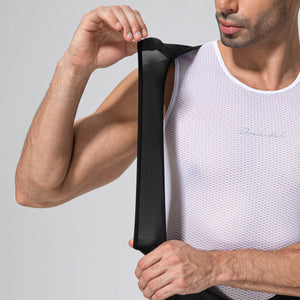
But loose stitching, a hem that repeatedly rides up or straps that can no longer maintain normal tension affect core performance.
At that point, you are no longer evaluating:
how old the bib looks.
You are evaluating:
whether the bib still works.
Why Cost Per Ride Is More Useful Than Purchase Price
Now we can return to the $40 question.
Suppose you buy a bib for:
$40.
If you wear it once, it cost:
$40 per ride.
If you use it 50 times:
$0.80 per ride.
If you use it 100 times:
$0.40 per ride.
If you use it 150 times:
about $0.27 per ride.
Those numbers are only illustrative mathematics—they are not a claim that every $40 bib will last exactly 50, 100 or 150 rides.
But they show why purchase price alone is incomplete.
The basic formula is simple:
Cost Per Ride = Purchase Price ÷ Useful Rides
Now imagine a hypothetical $150 premium bib.
If it delivers 100 useful rides:
$1.50 per ride.
If it delivers 400 useful rides:
about $0.38 per ride.
Again, these are hypothetical examples, not lifespan claims about a specific product.
The lesson is important:
The cheaper product is not automatically the better value.
And:
The more expensive product is not automatically the better value either.
Value depends on:
price × durability × how often you actually use the product.
That last part is easy to overlook.
A technically excellent $200 race bib that stays in your drawer because you only race six times per year may have a high cost per ride.
A $40 training bib you wear every week may deliver much more practical value.
The opposite can also be true:
if a cheap bib quickly loses support and needs replacing repeatedly, its low purchase price stops looking attractive.
So the correct goal is not:
lowest price.
It is:
lowest cost for the performance you genuinely use.
What Determines How Long a Bib Actually Lasts?
You cannot control every variable.
But you can influence several of the biggest ones.
Washing matters
Bib shorts sit directly against the body and chamois, so proper cleaning matters.
PEARL iZUMi currently recommends washing chamois-equipped shorts after each ride with cold water and mild detergent, then hang drying them. It specifically advises avoiding fabric softener and high heat because they can degrade stretch, moisture-management performance and pad structure.
Castelli gives similar apparel-care guidance: wash at no more than 30°C, avoid fabric softener and bleach, and hang or flat dry instead of tumble drying. Castelli states that careful care helps extend the useful life of performance garments.
The current Przewalski Classic care instructions follow the same general approach: wash inside-out on a gentle cold/low-temperature cycle, air dry, and avoid fabric softener and high-heat drying because those can reduce wicking performance and elastic recovery.
So care is not an afterthought.
It is part of the cost-per-ride equation.
Heat is especially important
Technical cycling shorts rely heavily on stretch fibers.
That is why several cycling apparel brands explicitly warn against high-temperature drying.
You may save ten minutes with a hot dryer.
But shortening the working life of the stretch system is a poor trade if your goal is long-term value.
Fabric softener is not your bib's friend
Performance apparel manufacturers repeatedly recommend avoiding it because it can interfere with the materials responsible for stretch and moisture management.
Rotation can make ownership easier
If you train frequently, owning multiple reliable bibs has practical advantages.
You can wash one,
air dry another,
and still have a clean pair ready.
Rotation does not magically eliminate wear—the garment still experiences a wash after use—but it spreads your weekly use across several pairs and gives each garment time to dry fully before the next session.
This is particularly relevant for indoor riders training several times each week.
Best $40 bib shorts for indoor cycling and Zwift
What Should Long-Term Value Look Like in a $40 Bib?
Now we can judge a $40 product differently.
If the only selling point is:
“cheap today,”
that is not enough.
A good $40 bib should be designed around repeated everyday use.
That means the parts most responsible for continued performance should already receive attention:
Chamois structure
Will the pad continue providing the intended support?
Fabric recovery
Can the garment maintain the close fit needed for stability?
Seam construction
Will repeated movement and washing challenge weak joins?
Straps
Can they maintain shape and tension?
Leg hold
Will the lower garment continue staying in place?
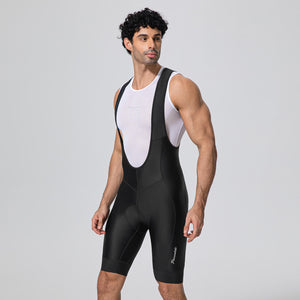
The current Przewalski Classic costs $40 and is explicitly positioned as an everyday training product. Its current page describes four-needle/six-thread panel seams for repeated use, a nylon/elastane fabric designed for stretch and recovery, 6 cm mesh straps with published stretch-recovery data, and herringbone chamois stitching intended to stabilize the pad through riding and frequent washing.
The brand also positions the Classic for road, gravel, mountain and indoor training rides up to about four hours.
That positioning matters.
Because the $40 value proposition should not be:
Buy this because it costs less today.
It should be:
Buy this because it is built for the everyday rides you are likely to repeat.
Repeated use is where cost per ride is created.
See the Przewalski Classic everyday training specification
Can an Expensive Bib Be Better Value Than a $40 Bib?
Absolutely.
And this is important for keeping the argument credible.
Suppose a more expensive bib gives you:
a chamois that fits your anatomy significantly better,
a fabric that performs better in the conditions you ride most,
a fit you consistently prefer,
or specialized endurance performance you use every weekend.
If you reach for that bib constantly and keep using it for a long time:
its cost per ride can become very reasonable.
That is real value.
So we should not say:
$40 is always better value than $150.
The better rule is:
Do not pay for performance you rarely use—but do not avoid paying for performance you repeatedly benefit from.
This is the same distinction running through the entire $40 series.
For a cyclist whose normal rides are:
one to four hours,
road,
gravel,
indoor,
or recreational trail,
a versatile $40 product may already cover most weekly riding.
For another rider doing:
six-hour gravel events,
high-level road racing,
or highly technical MTB,
specialization may be worth paying for.
Best bib shorts for 2–4 hour rides: do you really need a $150 bib?
The point is not to keep the purchase price as low as possible.
The point is to make sure:
the performance you pay for actually gets used.
A Better Way to Compare Two Bib Shorts
Instead of comparing only:
$40 vs $150
try comparing these five questions.
| Question | Why It Matters |
|---|---|
| Does it fit correctly? | A bib you avoid wearing has poor value |
| Does the chamois suit your normal rides? | Unused endurance capability adds little |
| Will you wear it across multiple scenarios? | Versatility can increase ride count |
| Does it maintain its performance with normal care? | Useful lifespan determines real cost |
| Can you explain what extra money buys? | Specialization should solve a real need |
This produces a much more useful buying decision.
A $40 bib used frequently and maintained correctly can be better value than a more expensive product you rarely need.
A premium bib used constantly for its specialized advantages can also be excellent value.
What makes little sense is:
paying more simply because:
more expensive = more serious cyclist.
Price is not rider ability.
It is not ride duration.
And it is not a lifespan rating.
Final Verdict: How Long Should a Good $40 Bib Last?
There is no responsible single answer such as:
one year,
5,000 miles,
or
100 rides.
PEARL iZUMi's current guidance is more useful: lifespan varies with ride frequency, care and mileage, and replacement becomes appropriate when the chamois is compressed, shifts or no longer provides its original support.
So judge lifespan by:
performance decline, not the calendar.
And judge value by:
useful rides, not purchase price alone.
That is especially important in the $40 category.
A $40 cycling bib does not become a good value simply because it is inexpensive.
It becomes good value if it gives you:
a stable chamois,
a fit that holds its shape,
reliable straps and leg openings,
durable seams,
appropriate support for your normal rides,
and enough versatility that you actually keep reaching for it.
The current Przewalski Men's Classic Cycling Bib Shorts cost $40 and are positioned exactly around repeated everyday use: training, indoor riding, road, gravel and mountain cycling, with an intended ride window of up to about four hours.
That leads us to the final principle of this entire $40 series:
$40 is not good value because the number is small.
$40 is good value when the product keeps doing the core job ride after ride.
And when the day comes that you genuinely need:
more endurance,
more cargo,
more technical terrain performance,
or a different chamois system,
then spending more makes sense.
Until then, the smarter number to watch may not be the price tag.
It may be:
cost per ride.
Explore the Przewalski Men's Classic Cycling Bib Shorts →
Regular Price: $40. The current model is positioned for everyday road, gravel, mountain and indoor training rides of up to about four hours, with cycling-specific construction intended for repeat use.
New customers can receive a one-time 10% discount by signing up through the pop-up on the Przewalski website.
Continue Reading
→Best $40 Cycling Bib Shorts in 2026
→What Makes a Good $40 Cycling Bib?
→Cycling Chamois Thickness & Density Explained
→Why Does Your Chamois Move While Riding?

