



What separates a good pair of cycling bib shorts from a bad one?
At first glance, the answer seems obvious.
A good chamois.
Stretchy fabric.
Comfortable straps.
Maybe a nice leg gripper.
But once you start comparing cycling bibs around $40, the question becomes more interesting.
At this price, some products already include real cycling-specific construction, while others rely heavily on a padded insert and a long list of marketing terms.
So what should $40 actually buy?
Not every feature found in a $150 or $200 racing bib.
But also not a pair of basic stretch shorts with foam sewn inside.
A good $40 cycling bib should already solve the fundamental problems of riding:
- Keep the chamois stable
- Fit closely without excessive restriction
- Move naturally while pedaling
- Keep the leg openings in position
- Distribute strap pressure
- Reduce avoidable seam friction
- Match the duration and riding style it claims to support
These are not luxury features.
They are the foundation of a cycling bib.
PEARL iZUMi's current bib-buying guide identifies many of the same fundamentals—chamois design, strap construction, leg openings, panel and seam layout, fabric characteristics and fit—as the details that determine how bib shorts perform once the ride gets longer.
That gives us a useful way to judge the $40 category.
The question is not:
How many premium technologies does this bib have?
It is:
Has the manufacturer already solved the core cycling problems before asking me to spend more?
What Should Core Performance Look Like at $40?
The easiest mistake is to judge a budget bib by the standards of a premium race product.
That is not useful.
A $40 everyday bib and a $200 race bib are not necessarily trying to solve exactly the same problem.
Premium products may add:
lighter fabrics,
more sophisticated compression,
advanced proprietary chamois systems,
more specialized aerodynamic patterning,
or highly specific hot-weather and endurance construction.
Those can all be legitimate reasons to spend more.
But the existence of premium technology should not lower the standard for basic products.
At $40, consumers should already expect:
a real chamois system,
a cycling-specific fit,
stable garment construction,
and
a clearly defined use case.
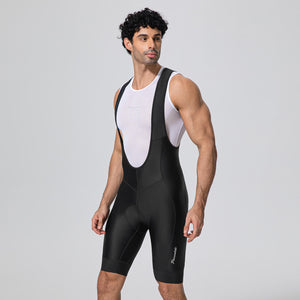
The current Przewalski Men's Classic Cycling Bib Shorts are priced at $40 and positioned for road, gravel, trail and everyday training rides of up to about four hours. The current specification includes a zoned chamois, 12-panel cut, 6 cm mesh straps, flat four-needle/six-thread seams and 6 cm leg grippers.
Those details provide a useful example of what core performance can look like at this price.
Not maximum specialization.
But a complete cycling product.
7 Details That Matter More Than the Price Tag
1. The Chamois Needs a Clear Purpose
The chamois is usually the first feature buyers look at.
That makes sense.
But the question should not simply be:
How thick is it?
A useful chamois should have a purpose connected to:
ride duration,
riding position,
support zones,
and the type of riding the bib is designed around.
As we covered in BLOG #9, thickness and density describe different things. Neither number automatically determines comfort.
What matters is how the pad is designed as a system.
At the $40 level, you should ideally be able to understand at least:
- What type of riding the pad targets
- Whether it uses one or multiple support zones
- The approximate cushioning level
- Whether the intended ride duration is clear
The current Przewalski Classic publishes an 18 mm zoned chamois, numerical foam-density zones and an intended ride range of up to about four hours.
Again, the value is not that 18 mm is universally better.
The value is that the buyer can understand what the pad is designed to do.
A good $40 bib should not require you to make a decision based only on labels such as:
“3D,”
“4D,”
or
“extra thick.”
Those names can describe products, but they are not substitutes for understanding the pad's intended function.
Cycling chamois thickness and density explained
2. Fit Should Stabilize the Pad Without Over-Compressing the Rider
A premium chamois inside the wrong fit is still the wrong bib.
Cycling bib shorts need to sit closer to the body than normal athletic shorts because the garment is helping keep the chamois positioned during thousands of repeated pedal strokes.
PEARL iZUMi currently describes good bib fit as close and supportive, without sagging or pinching. Its guidance specifically notes that wrinkles or chamois movement can indicate a fit that is too loose, while biting leg openings or restrictive straps can indicate the opposite problem.
That gives us a simple standard:
Too loose:
the pad can move.
Too tight:
the garment creates a new problem.
Correct:
the chamois stays stable while the rider can pedal normally.
This should already be achievable in a good $40 bib.
Compression itself is not a premium feature.
Correct compression is part of basic garment fit.
The more expensive product may provide more sophisticated compression characteristics.
But the $40 product should already know the difference between:
stable
and
restrictive.
Why does your chamois move while riding?
3. Panel Construction and Seam Placement Should Follow the Riding Position
A cycling bib should not behave like an ordinary pair of stretch shorts.
The body changes shape when you move from standing upright into a riding position.
The hips flex.
The torso rotates forward.
The thighs repeatedly move through a large range.
That is why panel construction matters.
Different panels allow designers to shape the garment around:
hips,
thighs,
glutes,
and the riding posture.
The important point is not that:
more panels are always better.
They are not.
Premium products can even reduce panel counts through more advanced patterning.
Rapha, for example, notes that one of its premium Pro Team designs uses fewer panels to reduce weight while maintaining its intended fit.
So the correct buying rule is:
Panel count is not a score.
The question is:
Does the cut help the garment stay smooth and stable while pedaling?
The Classic currently uses a 12-panel cut as part of its everyday fit architecture.
At $40, the important thing is not winning a panel-count competition.
It is demonstrating that the shorts have been:
patterned for cycling rather than simply stretched around the rider.
Seams are part of the same equation.
They should be:
secure,
relatively flat,
and positioned so repeated pedaling does not create unnecessary irritation.
Rapha's current bib guidance similarly highlights minimal seams and flatlock construction as tools for reducing irritation.
Przewalski's Classic uses four-needle, six-thread stitching specifically to create flatter, secure panel seams.
This is exactly the kind of detail that may look boring on a product page but becomes more important after two hours of repeated movement.
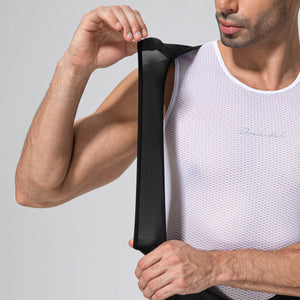
4. Straps Should Stabilize the Bib Without Becoming the Feature You Notice Most
Bib straps have a relatively simple job:
keep the garment in position without requiring a tight waistband.
Good straps should lie flat and maintain enough tension to help stabilize the shorts.
They should not dominate the ride.
PEARL iZUMi's current fit guidance recommends straps that sit snugly and flat without pulling excessively across the shoulders or chest.
This creates another useful $40 standard.
You do not necessarily need:
laser-cut premium suspenders,
ultralight woven straps,
or highly complex race-specific strap architecture.
But you should already expect:
- Reasonable width
- Breathability
- Flat placement
- Stable tension
- No obvious twisting
- No constant shoulder digging
The current Classic uses 6 cm breathable mesh straps, prioritizing width, ventilation and everyday support.
That design is different from a premium race bib using narrower or more technical strap systems.
And that is fine.
The $40 question is not:
Are these the most technologically advanced straps in cycling?
It is:
Do they perform the basic stability and pressure-distribution job correctly?
If yes, core performance is working.
5. Leg Openings Should Hold Without Becoming a Tourniquet
Leg grippers are another feature shoppers often underestimate.
A leg opening helps stabilize the lower part of the shorts.
If the hem repeatedly moves upward, the fabric tension above it can also change.
That can eventually affect:
fit,
seam position,
and even chamois stability.
But stronger grip is not automatically better.
PEARL iZUMi's guidance describes the ideal as leg openings that hold without digging into the rider, while its current Quest Bib also emphasizes preventing ride-up without excessive pressure.
That is the correct target:
stay put without punishing the thigh.
The current Przewalski Classic uses 6 cm-wide leg grippers designed to reduce leg ride-up and unwanted pad movement.
Again:
6 cm is not automatically superior to:
5 cm,
4 cm,
or a raw-cut integrated hem.
Premium products sometimes use completely different solutions.
Rapha, for example, has race products that eliminate traditional grippers through raw-edge construction.
The lesson is therefore not:
Buy the widest gripper.
It is:
Look for a deliberate solution to keeping the hem stable.
At $40, that solution should already exist.
6. Fabric Should Balance Stretch, Support and Breathability
Fabric descriptions are another area where marketing can overwhelm useful information.
Four-way stretch.
Compression.
Quick-dry.
Breathable.
Moisture-wicking.
Those words are common.
The more useful question is:
What does the fabric need to do for this particular bib?
For everyday cycling, the material normally needs enough stretch to follow hip and thigh movement while maintaining enough recovery to keep the garment close to the body.
It also needs to handle sweat and repeated use without immediately losing its intended fit.
PEARL iZUMi's current bib guide treats fabric weight and density as a balance between support, compression, ventilation and durability rather than one dimension where more is automatically better.
That is an important distinction.
A lightweight summer race bib and an everyday training bib may deliberately choose different material strategies.
The current Przewalski Classic uses a nylon/elastane main fabric alongside breathable mesh in the upper construction and is positioned as a versatile everyday training product rather than an ultralight race-specific garment.
That means the correct question is not:
Is this the lightest fabric available?
It is:
Does the fabric match the product's actual job?
At $40, the buyer should already receive fabric selected for cycling-specific:
stretch,
support,
and repeated movement.
Premium prices should then buy more specialized fabric behavior.
7. The Product Should Tell You What It Is—and What It Is Not
This final detail is not a piece of fabric.
But it may be one of the most important indicators of a serious product.
A good cycling bib should have a reasonably clear performance envelope.
The shopper should know whether the product is designed around:
45-minute training,
2–4 hour everyday riding,
long-distance endurance,
hot-weather racing,
gravel storage,
or technical MTB.
Why?
Because without that information, consumers often assume:
more expensive = more comfortable,
more padding = longer rides,
or
more features = better product.
Those assumptions are unreliable.
Przewalski's own current product range demonstrates how useful clear product segmentation can be. The Classic currently sits at $40 for everyday riding, while the Long Distance and Gravel models are listed at $75, and the dedicated Road Bib at $95.
The value of that ladder is not simply that more expensive products exist.
It tells the buyer:
what the additional money is meant to solve.
For the Classic:
everyday versatility and roughly up-to-four-hour riding.
For longer-distance products:
more endurance-oriented support.
For specialized road products:
a more performance-specific design.
This is how affordable equipment should work.
The $40 product should clearly explain the core job it performs.
Then the more expensive product should explain:
what new requirement the extra money addresses.
That is much more useful than dividing cycling equipment into:
“cheap”
and
“serious.”
When Is It Worth Spending More Than $40?
Once those seven fundamentals are working, spending more becomes much easier to justify.
Because now the extra money can buy:
specialization
rather than correcting missing basics.
Paying more can make sense if you need:
Longer endurance support.
Your normal rides have moved well beyond four hours.
More storage.
You regularly need cargo capacity for gravel or self-supported riding.
More aggressive race fit.
Your priority is high-intensity road performance or aerodynamic positioning.
Greater heat specialization.
You spend most of your riding time in extreme heat and want significantly lighter construction.
More technical off-road construction.
Abrasion resistance, outer-short compatibility or MTB-specific mobility has become important.
A different chamois.
You already know the everyday pad does not match your anatomy or riding position.
Przewalski's current product ladder reflects some of these distinctions: the Classic remains at $40, while the brand's Long Distance and Gravel bibs are currently $75 and its road-specific model is $95.
This does not mean:
$75 = good
and
$40 = basic.
It means:
the price should rise when the requirement rises.
That is the buying principle we have used throughout this series:
Pay more when you can name the problem the extra money solves.
How Does the $40 Przewalski Classic Measure Against These 7 Standards?
Now we can evaluate the Classic without simply saying:
“good value.”
Instead, use the same framework we would apply to any $40 bib.
| What to Check | Current Przewalski Classic |
|---|---|
| Chamois | 18 mm zoned, published multi-density structure |
| Fit | Close everyday cycling fit |
| Panel construction | 12-panel cut |
| Seams | Four-needle, six-thread construction |
| Straps | 6 cm breathable mesh |
| Leg hold | 6 cm grippers |
| Intended use | Road, gravel, trail and training; up to about 4H |
Current official specifications checked August 2026.
That does not mean:
seven checks = universally perfect bib.
There are still individual variables:
body shape,
saddle,
riding position,
temperature,
compression preference,
and chamois preference.
No specification table can guarantee personal comfort.
What the table does show is something more defensible:
At $40, the product already has a complete cycling-specific construction story.
The chamois is not being asked to carry the entire product.
Fit,
panels,
straps,
seams,
leg openings,
and fabric
all contribute to the final result.
That is exactly the standard a good $40 bib should meet.
See the complete Przewalski Classic construction
Final Verdict: A Good $40 Bib Should Feel Complete, Not Cheap
A good $40 cycling bib does not need to compete with every premium product on every specification.
That is not the goal.
It does not need:
the lightest fabric,
the most advanced race insert,
the highest compression,
the longest endurance rating,
or the most complicated construction.
But it should feel like a complete cycling product.
That means:
the chamois has a purpose,
the fit stabilizes it,
the panel shape follows the rider,
the seams do not become unnecessary friction points,
the straps support rather than distract,
the leg openings stay in position,
and the fabric matches the intended ride.
Those are not premium extras.
They are:
core performance.
That is the standard consumers should apply to the $40 category.
And it is also why the conversation around budget cycling bibs should move away from:
Is this cheap enough?
toward:
How much real cycling performance am I getting for the money?
The current Przewalski Men's Classic Cycling Bib Shorts are positioned directly around that idea.
Regular price: $40.
Not because $40 is the lowest possible price.
But because $40 can already buy:
a zoned chamois,
cycling-specific panel construction,
breathable straps,
stable leg openings,
flat seams,
and a defined everyday 1–4 hour riding role.
From there, spending more should add something specific:
longer endurance,
more storage,
lighter race materials,
greater heat specialization,
or more technical terrain performance.
The principle is simple:
$40 should buy the fundamentals.
More money should buy specialization.
If a $40 bib is missing the fundamentals, it is not inexpensive performance.
It is simply missing performance.
And if a $40 bib already delivers the fundamentals you actually use:
you may not need to spend more yet.
Explore the Przewalski Men's Classic Cycling Bib Shorts →
Regular Price: $40. Current specifications include an 18 mm zoned chamois, 12-panel construction, 6 cm breathable mesh straps, 6 cm leg grippers and flat four-needle/six-thread seams, with the product positioned for everyday rides up to about four hours.
New customers can get 10% off their first purchase by signing up through the Przewalski website pop-up.
Continue Reading
→Best $40 Cycling Bib Shorts in 2026
→Cycling Chamois Thickness & Density Explained
→Why Does Your Chamois Move While Riding?

