



18 mm.
90 kg/m³.
120 kg/m³.
Dual density.
Multi-density.
3D.
4D.
Cycling bib shorts are full of numbers and padding terminology, but very few of those numbers are useful unless you understand what they actually describe.
The biggest mistake is also the simplest:
More padding must mean more comfort.
That is not how a cycling chamois works.
A pad is not simply a cushion placed between you and the saddle. Its performance depends on several things working together:
- Thickness
- Foam density
- Pad shape
- Zoned construction
- Pad dimensions
- Riding position
- Garment fit
- Chamois stability
- Saddle compatibility
Research comparing different cycling pads has found measurable differences in saddle pressure between pad constructions, while riders' subjective comfort ratings did not always match the objective pressure measurements. In other words, chamois performance cannot be reduced to one number or simply judged by which pad looks thicker.
That matters even more when you are shopping around $40.
At this price, you should not expect every premium chamois technology available in a $150–$250 bib.
But you should expect something much better than:
“It has a thick 4D pad.”
A good $40 bib should give you enough information to understand:
where the support is, what the pad is designed for, and whether it matches the riding you actually do.
What Do Chamois Thickness and Foam Density Actually Mean?
Thickness and density describe two different things.
They should not be treated as interchangeable.
Thickness tells you how deep the pad is
If a chamois lists:
18 mm
that describes the depth of a particular cushioning zone.
It does not tell you:
how firm the foam feels,
how quickly it compresses,
how well it recovers,
or whether the pad shape matches your body.
A thicker pad may give more room for cushioning.
But that does not automatically make it better.
Density tells you how much material exists within a given volume
When a cycling pad lists:
90 kg/m³
that is a foam-density specification.
Importantly:
density is not the same as a universal hardness score.
A higher-density foam generally contains more material within the same volume, but two foams with similar density can still behave differently depending on their formulation and construction.
So it is too simplistic to say:
120 kg/m³ is always better than 90 kg/m³.
Just as it is too simplistic to say:
18 mm is always better than 12 mm.
The useful question is:
Why did the manufacturer choose that thickness and density for that particular area of the pad?
That brings us to the most important concept:
zoning.
A cycling chamois does not necessarily need the same cushioning underneath every part of the rider.
Different contact areas can benefit from different structures.
Why Isn't a Thicker Chamois Always Better?
Because the rider is not sitting on a mattress.
During cycling, your contact with the saddle changes continuously.
Your pelvis position can change when you:
sit upright,
lower your torso,
move toward the front of the saddle,
move backward,
climb,
stand,
or increase cadence.
A 2023 review of cycling saddle-pressure research found that pressure can be influenced by multiple variables including sitting time, pedaling intensity, cadence, trunk and hand position, saddle setup and padded shorts.
That means the chamois is only one part of a larger system.
A very thick pad cannot automatically correct:
the wrong saddle,
the wrong bib size,
poor pad positioning,
or a chamois shape that does not suit the rider.
The 2015 study comparing different cycling pads is especially useful here. Different pad constructions produced different saddle-pressure results, but subjective comfort did not consistently match the objective pressure indexes.
That tells us two things.
First:
Pad construction matters.
Second:
Comfort remains individual.
So when a product page tells you only:
“extra thick padding”
that is not enough information to conclude that the product will be more comfortable.
Sometimes extra bulk may even become a disadvantage if the pad:
folds,
moves,
creates excessive material between the rider and saddle,
or simply does not match the rider's anatomy.
The better goal is:
enough cushioning in the right place, with enough support to remain useful through the intended ride.
→ Why does your chamois move while riding?
What Should You Expect From the Chamois in a $40 Bib?
This is where the price discussion becomes useful.
At $40, you should not expect every manufacturer to publish a laboratory manual.
And the absence of one particular numeric specification does not prove that a pad is poor.
But a serious $40 cycling bib should give the buyer enough information to understand what they are buying.
Ideally, you should be able to answer several questions.
What kind of riding is the pad designed for?
Short training?
Indoor?
Road?
Gravel?
Long endurance?
A chamois without a clear intended use is harder to evaluate.
Is it single-density, dual-density or zoned?
This gives you some indication of whether the pad treats every area equally or uses different support structures.
How thick is the main cushioning area?
Thickness alone does not determine performance, but it is still useful context.
Does the brand publish foam density?
Not every company does.
But when density is available, it gives the buyer another concrete specification to compare.
How large is the pad?
Pad footprint can affect coverage and how the chamois interfaces with different body proportions.
How is the pad kept stable inside the shorts?
The best foam in the world is less useful if the garment allows it to shift underneath the rider.
That last question is especially important.
A chamois specification should never be judged separately from:
fabric,
panels,
leg openings,
straps,
and overall fit.
What Does a $40 Chamois Look Like in Practice?
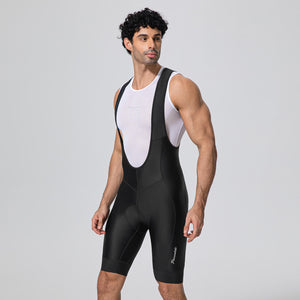
The current Przewalski Classic provides a useful example because the product currently costs $40 and publishes substantially more numeric pad information than simply stating “multi-density.”
The current specification includes:
18 mm zoned chamois
352 × 212 mm overall pad dimensions
30 / 90 / 90 / 30 kg/m³ zoned foam construction
Up to about four hours of intended riding
Road / gravel / mountain / indoor use.
The important point is not:
18 mm is the correct thickness for everyone.
It is:
the numbers are connected to a clear design purpose.
In the current Classic design, Przewalski describes different foam arrangements in the sit-bone and forward/perineal areas.
The sit-bone support area uses a layered structure incorporating two 90 kg/m³ support layers between lower-density transition layers, while the more forward area uses a 30 + 90 + 30 kg/m³ structure. The brand describes the design as an all-terrain pad intended to support different riding positions rather than using the same foam stack everywhere.
That is what “zoned” should actually mean:
not simply printing different colors onto a pad,
but changing the construction where the function changes.
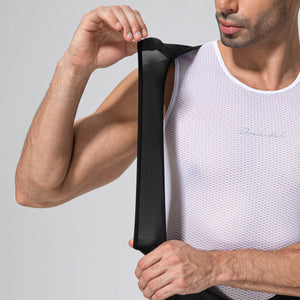
The Classic also uses a 352 × 212 mm pad footprint and herringbone stitching to secure the chamois within the shorts, while the surrounding bib uses 12-panel construction and 6 cm leg grippers to help maintain garment position.
Again:
none of those numbers guarantees individual comfort.
But they tell the buyer what the $40 product is trying to achieve.
That is the real value of specification transparency.
See the full Przewalski Classic chamois specification
Does More Foam Density Mean a Better Bib?
No.
This is where consumers can easily replace one oversimplification with another.
First they learn:
thicker isn't always better.
Then they start believing:
higher density must always be better.
That is not a useful rule either.
Consider the difference between everyday and longer-distance riding.
The current Classic uses key support zones around 90 kg/m³ and is positioned for rides up to about four hours.
Przewalski's more specialized Gravel Bib currently uses 120 kg/m³ foam with a 14 mm cushioning specification and an endurance positioning up to seven hours.
Notice what happened:
Classic
18 mm
with key 90 kg/m³ support zones
Gravel
14 mm
with 120 kg/m³ support
The more endurance-focused product is not simply:
thicker.
In this example, it uses a higher-density but thinner support structure as part of a different design brief.
That is an excellent illustration of why buying by one number does not work.
The Gravel Bib also adds:
more compression,
abrasion-focused construction,
five pockets,
and a longer endurance target.
So the extra cost is not:
“Pay more and receive more millimeters.”
It is:
Pay more for a different system designed around a different ride.
That is exactly how the $40 price conversation should work.
If your normal rides are:
90 minutes,
two hours,
three hours,
occasionally four hours,
you do not automatically need the foam structure designed around a longer endurance product.
If you regularly ride:
five,
six,
or seven hours,
the requirements begin to change.
→ Do you really need a more expensive bib for 2–4 hour rides?
What Does the Same $40 Price Tell Us About Chamois Transparency?
There is another useful comparison at exactly the same price.
The Black Bibs Original currently costs $40 and its official page describes a dual-density Coolmax chamois, high-compression fabric and mesh straps.
Its current official product page does not publish numerical chamois thickness, numerical foam densities or overall pad dimensions.
That does not mean:
The Black Bibs pad is worse.
It means:
the two $40 products give shoppers different levels of technical information before purchase.
At the same current $40 price:
| Chamois Information | Przewalski Classic | The Black Bibs Original |
|---|---|---|
| Price | $40 | $40 |
| Density description | Zoned / multi-density | Dual density |
| Numerical foam density | Published | Not listed on current official page |
| Thickness | 18 mm zoned | Not listed on current official page |
| Pad dimensions | 352 × 212 mm | Not listed on current official page |
| Intended ride window | Up to about 4H | Brand describes all-day riding |
| Design philosophy | Specification-led versatility | Minimalist / compression-focused |
Current official product pages checked August 2026.
This table should not be read as:
more numbers = automatically better comfort.
That would repeat the exact mistake this article is trying to avoid.
The advantage of more published numbers is different:
they make the product easier to evaluate before purchase.
For some buyers, The Black Bibs' simpler approach may be completely sufficient.
For shoppers who want to understand:
pad thickness,
density zoning,
pad size,
and intended duration
before spending the same $40, Przewalski provides more information to work with.
→ Przewalski vs The Black Bibs: Which $40 Bib Should You Buy?
How Should You Judge a Chamois Before Buying?
Instead of asking:
How thick is it?
use a better sequence.
1. Does the pad match your normal ride duration?
A two-hour training bib and a seven-hour endurance bib do not need identical construction.
2. Does the brand explain where the support is?
Look for:
zoning,
density changes,
different thickness areas,
or at least a clear description of the pad design.
3. Does the pad match your riding position?
More upright riding and lower road positions shift how the rider contacts the saddle. Saddle-pressure research confirms that trunk and riding position are among the variables affecting pressure distribution.
4. Will the garment keep the pad stable?
Check:
compression,
panel construction,
leg grippers,
and sizing.
A chamois is part of the bib.
It is not an independent accessory floating inside it.
5. Does the pad work with your anatomy and saddle?
This part cannot be solved entirely from a specification sheet.
Research on cycling pads has shown that objective pressure measurements and subjective comfort do not always align perfectly.
That is why two riders can disagree completely about the same chamois.
6. Are you paying for a feature you actually need?
If your normal ride lasts two hours, buying a more specialized endurance pad simply because its density number is higher may not create meaningful value.
This is the same rule we have used throughout this series:
Pay more when you can identify the problem the extra performance solves.
Final Verdict: What Should You Expect From a $40 Chamois?
A $40 bib does not need the most complicated pad in cycling.
It does not need:
the highest foam density,
the greatest thickness,
the longest endurance rating,
or the most impressive marketing name.
What it should have is:
a chamois with a clear job.
You should be able to understand:
where it provides support,
what type of riding it is designed around,
how long the intended rides are,
and how the garment helps keep the pad stable.
That is the difference between:
cheap padding
and
affordable performance.
The current Przewalski Classic is a useful example of the second approach.
At a regular price of $40, it publishes:
18 mm zoned cushioning
30 / 90 / 90 / 30 kg/m³ foam structure
352 × 212 mm pad dimensions
up-to-four-hour positioning
and a surrounding 12-panel bib structure designed to keep the chamois stable through everyday road, gravel, trail and indoor riding.
Those specifications do not make it automatically better than every $40 competitor.
They make its design intent easier to understand.
And that is exactly what a serious $40 cycling bib should offer:
enough information to make an informed decision.
The most important lesson is not:
Buy the thickest chamois.
It is not:
Buy the highest-density chamois.
And it is not:
Buy the most expensive chamois.
It is:
BUY THE PAD THAT MATCHES THE RIDING YOU ACTUALLY DO.
For many everyday riders doing one-to-four-hour training rides, the goal is not to pay for maximum endurance specialization.
It is to get:
stable support,
clear construction,
appropriate cushioning,
and a bib that keeps the pad where it belongs.
That is the standard a $40 performance bib should be judged against.
Explore the Przewalski Men's Classic Cycling Bib Shorts →
Regular Price: $40. The current product publishes an 18 mm zoned chamois, numeric foam densities, a 352 × 212 mm pad footprint and an intended ride window of up to about four hours.
Eligible new customers can also receive the one-time 10% new-customer sign-up offer through the Przewalski website registration pop-up.
Continue Reading
→Best $40 Cycling Bib Shorts in 2026
→Best Bib Shorts for 2–4 Hour Rides

