
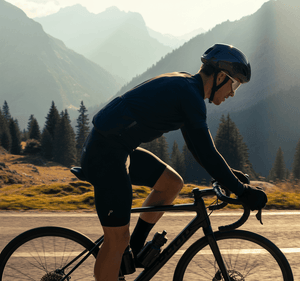
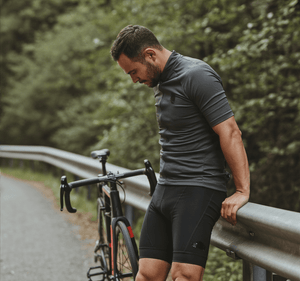


Road bike.
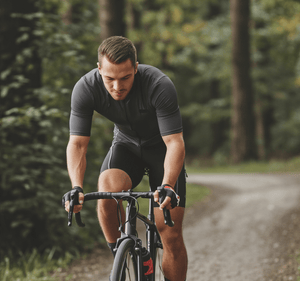
Gravel bike.
Mountain bike.
Three different bikes can quickly turn into three different wardrobes.
Road bibs.
Cargo gravel bibs.
MTB liners.
Endurance bibs.
Race bibs.
But if most of your rides last between one and four hours, do you really need a different pair of bib shorts every time the surface changes?
Or can one well-designed $40 cycling bib cover most of the riding you actually do?
For many everyday cyclists, the answer is:
one versatile bib can cover much more than you might think.
Road, gravel and mountain biking are different disciplines, but a cycling bib still has the same fundamental jobs:
- Keep the chamois in the correct position
- Support the rider through repeated pedaling
- Move with the hips and thighs
- Control friction
- Keep the leg openings stable
- Manage moisture
- Stay comfortable as riding position changes
What changes between disciplines is not the basic purpose of the bib.
What changes is the point at which you start needing specialized features.
That distinction is particularly important around the $40 price level.
A $40 bib does not need to imitate every feature of a $75 gravel bib, a dedicated MTB liner or a premium road-racing product.
But it should already be versatile enough to handle the normal riding most cyclists actually do.
That is exactly where the current Przewalski Men's Classic Cycling Bib Shorts are positioned: a $40 regular-price bib built for road, gravel, mountain/trail and training rides of up to about four hours.
So the question for this guide is not:
Which cycling discipline has the best bib shorts?
It is:
How much versatility should $40 already buy you?
What Should a $40 Versatile Bib Actually Do?
Versatility should not mean:
It technically fits under three different jerseys.
A truly versatile bib should continue doing its fundamental job when the riding surface, body position and intensity change.
At around $40, you should already expect a proper cycling bib to provide:
A stable chamois.
The pad should remain underneath the areas it is designed to support instead of constantly shifting when you stand, climb or change position.
Enough stretch for different riding positions.
Road, gravel and MTB all require changes in hip angle and body position.
Secure leg openings.
The shorts should stay in place through repeated pedaling without relying on excessive pressure.
Breathable straps and upper construction.
A multi-purpose training bib needs to work both outside and indoors.
Low-friction seams.
Changing terrain does not make inner-thigh friction less important.
A realistic ride-duration target.
The product should make it reasonably clear whether it is intended for short training, everyday riding or long-distance endurance.
This is the minimum standard we should expect when talking about a:
performance-focused $40 bib
rather than simply a cheap pair of padded shorts.
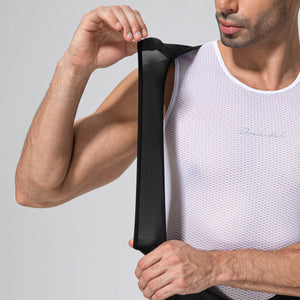
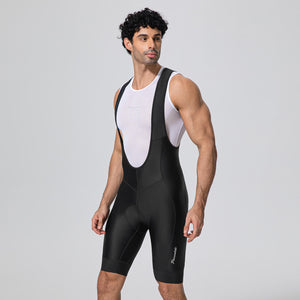
The Przewalski Classic currently publishes an 18 mm zoned chamois with 30/90/90/30 kg/m³ foam zones, a 12-panel construction, 6 cm breathable mesh straps, flat four-needle/six-thread seams and 6 cm leg grippers. The brand positions the product for road, gravel, mountain and indoor training, with an intended ride window of up to about four hours.
No single one of those specifications guarantees comfort for every rider.
What matters is that the $40 product is built as a complete garment system, not simply around the thickness of the pad.
That is an important difference.
At $40, versatility should come from fit and construction—not from pretending one product is specialized for everything.
See the Przewalski Men's Classic Cycling Bib Shorts
Best $40 Cycling Bib Shorts in 2026
Can One $40 Bib Work for Road, Gravel and MTB?
For normal everyday riding:
yes.
The reason is that the core clothing requirements of these disciplines overlap considerably.
You do not suddenly need a completely different chamois because asphalt changes into packed gravel.
And a bib does not stop stabilizing the pad simply because you move from a road bike to an XC mountain bike.
Where the differences become important is when the demands of the ride change enough to justify additional features.
Road: A $40 Bib Should Already Cover Everyday Training
Road riding is probably the easiest discipline to understand.
A large part of a normal road ride involves sustained seated pedaling.
You will still:
stand on climbs,
sprint,
move forward and backward,
change hand positions,
and alter your torso angle,
but pad stability and repeated pedaling remain central.
For this type of riding, a good $40 bib should already provide:
- Stable compression
- A chamois that stays centered
- Flat seams
- Secure leg openings
- Breathable straps
- Enough stretch to move between relaxed and lower riding positions
The current Classic specifically uses a 12-panel construction and high-stretch fabric designed to remain secure as riding position changes, while its all-terrain chamois is positioned for road use within its up-to-four-hour range.
For:
60-minute training rides,
two-hour weekend rides,
or
three-hour normal road sessions,
there is no rule that says the rider must automatically move into a more expensive road-specific bib.
The important question is whether the $40 product already solves the problems the ride creates.
If it does:
specialization becomes optional.
Do you really need a $150 bib for a 2–4 hour ride?
Gravel: Changing the Surface Does Not Automatically Require a New Bib
Gravel is where versatile cycling clothing makes particularly good sense.
A normal gravel ride may move between:
pavement,
broken pavement,
hard-packed dirt,
light gravel,
short rough sections,
and back onto smooth roads.
The rider is still pedaling.
The chamois still needs to stay in place.
The shorts still need to move with the body.
For a normal two- or three-hour gravel ride, those basic requirements are not radically different from road training.
That is why the current Przewalski Classic includes gravel within its intended all-terrain use rather than treating gravel as an entirely separate product category.
So if your gravel riding looks like:
- 2–3 hours
- normal jersey pockets
- moderate mixed surfaces
then a $40 versatile bib may already solve the clothing problem.
Simply purchasing a gravel bike does not automatically create a need for a gravel-specific bib.
The need appears when gravel introduces a new requirement.
For example:
more cargo,
longer duration,
rougher surfaces,
or greater abrasion exposure.
That is when spending above $40 begins to make more sense.
MTB: A Versatile Bib Can Work Until the Riding Becomes More Technical
Mountain biking requires a little more nuance.
Yes, bib shorts can absolutely be used for mountain biking.
Dedicated MTB liners themselves use the same basic idea: a padded cycling layer worn beneath trail shorts or pants.
Specialized's current Prime SWAT Liner Bib Shorts, for example, are specifically designed to sit underneath trail shorts or pants and use highly breathable open mesh, integrated storage and leg grippers to keep the liner stable.
That tells us something important:
Bib construction is not inherently road-only.
For:
recreational trails,
XC riding,
moderate off-road training,
or shorter MTB sessions,
a versatile bib can work perfectly well if the pad remains stable and the garment allows enough movement.
The Classic's current intended use includes mountain riding, and its stretch and multi-panel construction are designed to accommodate changes between seated, standing and lower riding positions.
Where things begin to change is:
technical MTB.
More aggressive riding introduces more:
standing,
descending,
large body-position changes,
rough terrain,
walking,
protective equipment,
and interaction with outer trail shorts.
Now the clothing problem is changing.
And once the problem changes, specialization becomes easier to justify.
Where Does a $40 Versatile Bib Reach Its Limits?
This is the part that keeps “versatile” from becoming an empty marketing claim.
A $40 bib can cover a lot of normal cycling.
But it should have clear boundaries.
There are four situations where moving into a more specialized product starts to make sense.
Your rides regularly exceed four hours. If a normal gravel or road ride has grown from two or three hours into five, six or seven hours, long-distance support becomes a real requirement rather than an occasional feature.
You need integrated cargo. Jersey pockets may be completely adequate for normal road and gravel rides. But self-supported gravel or MTB can create much stronger demand for phone, food and tool storage directly on the bib.
Your terrain becomes significantly rougher. More abrasive environments can justify tougher fabrics and more terrain-specific construction.
Your mountain biking becomes highly technical. Frequent standing, descending, walking, outer shorts and protection can make an MTB-specific liner or bib more useful.
This distinction matters because it prevents us from making the wrong claim.
We are not saying:
A $40 Classic replaces every road, gravel and MTB product.
We are saying:
A $40 versatile bib can cover the normal overlap between those disciplines before specialization becomes necessary.
That is a much stronger and more credible value proposition.
What Are You Paying for When You Move Above $40?
Once you understand the limits, the price ladder becomes easier to understand.
Moving from a $40 everyday bib to a more specialized $75 product should buy you something identifiable.
Not simply:
“premium.”
Przewalski's own current lineup makes this easy to see.
The Classic remains $40, while the dedicated Gravel and MTB Racing Bib Shorts are both currently listed at $75.
That additional $35 is not simply paying for a different category name.
The specialized products address additional problems.
The current Gravel Bib is designed for long-distance mixed-surface riding and adds abrasion-focused construction, medium-high compression, a five-pocket storage system and an endurance target of up to seven hours.
The current $75 MTB Racing Bib adds MTB-specific fit, abrasion-oriented fabric, dual side pockets, protection-friendly leg construction, cross-back straps and a pad designed around more standing, climbing, descending and position changes.
That gives us a much cleaner price comparison:
| What You're Buying | $40 Versatile Bib | $75 Specialized Bib |
|---|---|---|
| Road training | Yes | Yes |
| Normal gravel | Yes | Yes |
| Recreational MTB | Yes | Yes |
| Indoor training | Yes | Depends on model |
| Up to about 4H | Core use | Easily overlaps |
| 5–7H endurance focus | Not primary purpose | More relevant |
| Cargo storage | Not a core feature | Often added |
| Abrasion-specific construction | General everyday use | Greater priority |
| Technical MTB features | Limited | Purpose-built |
| Main value | Versatility | Specialization |
This is how cyclists should think about paying more.
Not:
$75 must be better than $40.
But:
What new problem does the extra $35 solve?
If you need five pockets for six-hour gravel rides:
the additional spend makes sense.
If you ride technical MTB several times per week:
the additional spend makes sense.
If you mostly ride:
90-minute road,
two-hour gravel,
and occasional XC trails,
you may be paying for specialization you rarely use.
That is the central value argument.
Spend more when your riding creates a requirement that the $40 bib no longer solves.
Why the Przewalski Classic Fits the $40 Versatile Role
Now the position of the Classic becomes much clearer.
It is not designed to win every specialist category.
It is not the:
most cargo-focused gravel bib,
most technical MTB liner,
longest-distance endurance bib,
or most aggressive road-racing product.
Its role is different.
It is designed around the overlap.
The current Classic costs $40 and publishes the following core construction:
- 18 mm zoned chamois
- 30/90/90/30 kg/m³ foam structure
- 12-panel anatomical cut
- 6 cm breathable mesh straps
- 6 cm leg grippers
- Flat four-needle, six-thread seams
- High-stretch nylon/elastane construction
- Road / gravel / mountain / indoor use
- Up to about four hours of intended riding.
That combination explains what the product is actually trying to do.
Not:
“be the best at everything.”
But:
“work reliably across the riding most everyday cyclists actually do.”
Consider a rider whose week looks like:
Tuesday
60-minute indoor trainer session
Thursday
90-minute road ride
Saturday
2.5-hour gravel ride
Occasional Sunday
XC trail ride
How many specialist bibs does that rider genuinely need?
Potentially:
one.
That is where a $40 versatile product creates value that cannot be measured only by counting extra features.
The value comes from:
how many normal rides one product can cover.
This also makes a versatile $40 bib particularly logical for beginners.
A new cyclist may not yet know whether they will eventually prefer:
road,
gravel,
indoor training,
or mountain biking.
Buying separate specialist bibs before those preferences exist means paying for needs that may never develop.
Starting with one flexible product allows the rider to learn:
- Preferred chamois feel
- Compression preference
- Normal ride duration
- Whether cargo matters
- Whether gravel becomes a major discipline
- Whether MTB becomes more technical
Then upgrade when a real requirement appears.
How to choose your first cycling bib shorts
A Better Way to Decide Whether You Need Another Bib
Before buying a dedicated road, gravel or MTB bib, ask one question:
What problem am I trying to solve that my current bib cannot solve?
If the answer is:
My gravel rides have grown to six hours.
That is a real reason.
I need storage for food and tools.
Real reason.
My MTB riding now involves technical trails, outer shorts and protective equipment.
Real reason.
My road racing position needs a more specific performance fit.
Real reason.
But:
I just bought a gravel bike.
That alone is not a clothing requirement.
And:
This product says “MTB” on the name.
That alone is not a performance requirement either.
The bicycle category should not automatically decide your wardrobe.
The ride should create the requirement.
This is especially important when the alternative is moving from a $40 product you already know works into a more expensive specialist product.
The additional money should solve something.
If you cannot clearly identify what that is:
you may not need to specialize yet.
Final Verdict: How Much Versatility Should $40 Buy?
Quite a lot.
A $40 cycling bib should not be treated as a disposable entry-level product that only works in one narrow scenario.
If it is properly designed, it should already be capable of handling a broad range of everyday riding.
For normal:
road training
gravel riding
recreational MTB
indoor training
and especially rides inside the one-to-four-hour range,
the fundamental clothing needs overlap enough that one versatile bib can make a lot of sense.
The current Przewalski Classic is deliberately positioned in that overlap:
$40
Road + Gravel + Mountain + Indoor
Up to About 4 Hours
That does not mean the Classic replaces specialized products.
Przewalski itself sells $75 Gravel and MTB products because longer, rougher and more technical riding creates additional needs.
That is exactly the point.
A healthy product ladder should look like:
Everyday Riding
$40 versatile performance
↓
Longer / Rougher / More Specialized Riding
Pay more for the additional requirement
Not:
Beginner
Buy cheap
↓
Serious cyclist
Automatically buy expensive
The rider should upgrade because the ride changed, not because the rider believes a higher price automatically means a better experience.
So if your riding week includes:
road,
gravel,
trainer sessions,
and occasional recreational trails,
you may not need four different bib shorts.
You may simply need:
one good $40 bib that was designed to cover the overlap.
That is the value proposition the Przewalski Classic should own.
Not:
$40 because it is cheap.
But:
$40 because it already covers the core performance most everyday rides require.
And when you finally outgrow that performance envelope:
you will know exactly why you are spending more.
Explore the Przewalski Men's Classic Cycling Bib Shorts →
Regular Price: $40
Designed for road, gravel, mountain/trail and indoor training rides of up to about four hours.
Eligible new customers can also receive a one-time 10% new-customer sign-up offer through the Przewalski website registration pop-up.
Continue Reading
→ Best $40 Cycling Bib Shorts in 2026
→ Przewalski vs The Black Bibs
→ Best Beginner Cycling Bib Shorts
→ Best Bib Shorts for 2–4 Hour Rides

