
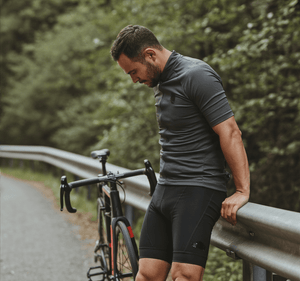


A two-hour ride and a six-hour ride are not the same equipment problem.
Yet cyclists are often encouraged to shop as if they were.
Search for premium cycling bib shorts and it is easy to find endurance products well above $150. Castelli's current Endurance 4 Bibshort is listed at $175 in the U.S., while the ASSOS MILLE GT S11 EF is currently $230. Both are positioned around endurance-oriented comfort and longer riding.
Those products may make perfect sense for the rider they are designed for.
But if most of your rides are:
- 90 minutes
- Two hours
- Three hours
- Occasionally four hours
the more useful question is not:
“What is the best bib I can afford?”
It is:
“What level of bib performance does my actual ride require?”
A $200 endurance bib can offer premium fabrics, sophisticated pad systems, refined compression and highly developed construction.
But that does not automatically mean a rider doing a two-hour weekday session needs all of those features.
For regular two-to-four-hour riding, the priority is usually much simpler:
correct pad support + stable fit + controlled friction + breathable construction + a garment that stays where it belongs.
First: What Actually Changes as a Ride Gets Longer?
The difference between a short spin and several hours in the saddle is not simply:
“You need more foam.”
As riding time increases, several small fit and comfort issues have more opportunity to become noticeable:
- Pad movement
- Seam friction
- Moisture accumulation
- Leg-opening movement
- Shoulder-strap pressure
- Saddle pressure
- Fabric bunching
- Poor sizing
That is why ride duration matters.
A bib that feels perfectly acceptable for 45 minutes may reveal fit problems after repeated pedaling.
And a product designed for six- or seven-hour endurance use may include features that are unnecessary for someone whose normal ride ends after 90 minutes.
Padding Matters—but “More Padding” Is the Wrong Goal
A biomechanical study comparing cycling shorts with different pad constructions found that pad design could change measured saddle pressure during cycling. The takeaway is not that one specific thickness always wins; it is that pad structure matters, rather than padding being a simple more-is-better variable.
For two-to-four-hour rides, look at:
- Foam density
- Pad footprint
- Pressure zones
- Thickness
- Surface construction
- Position inside the shorts
rather than thickness alone.
→ Cycling chamois thickness and density explained
What Does a Good 2–4 Hour Bib Actually Need?
For most everyday riders, six areas matter.
1. A Pad Designed for the Intended Ride Window
If a manufacturer clearly defines a ride-duration range, use it as a product-positioning guide, not a medical guarantee.
For example, Przewalski currently positions its Classic Cycling Bib Shorts for rides of up to about four hours.
The same brand positions its Long Distance Cycling Bib Shorts for up to seven hours and uses a different pad and garment specification.
That distinction is useful.
It tells the buyer that the two products are solving different problems.
Classic
Everyday training
Indoor riding
Road
Gravel
Short-to-medium rides
Long Distance
Long saddle time
Endurance
Extended road and gravel use
More storage
Higher-density endurance support
This is a better way to choose than assuming:
higher-priced = automatically better for every ride.
2. Enough Density to Maintain Support
Thickness and density are not the same thing.
The Przewalski Classic currently publishes:
- Maximum chamois thickness of approximately 18 mm
- Multiple foam-density zones
- Higher-density 90 kg/m³ support layers in key areas
- A 352 × 212 mm pad footprint.
Its Long Distance model takes a different approach, publishing support foam up to 120 kg/m³, with a larger 360 × 210 mm pad and an endurance positioning of up to seven hours.
That comparison illustrates an important principle:
Longer-duration design is not simply “make the pad thicker.”
The Long Distance product actually lists a lower maximum sit-bone cushioning thickness in parts of its structure, but uses higher-density foam and a different overall system.
So do not shop by thickness alone.
3. The Chamois Has to Stay in Position
A great pad in the wrong place is still a problem.
During a two-to-four-hour ride, you may repeatedly:
- Move forward on the saddle
- Sit farther back
- Stand
- Climb
- Accelerate
- Rotate your pelvis
- Change hand position
The shorts therefore need to stabilize the pad through all of those movements.
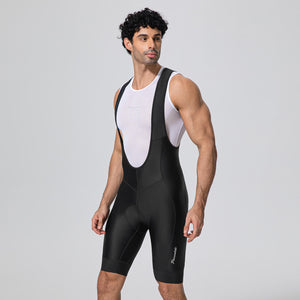
The Przewalski Classic uses:
- 12-panel construction
- 6 cm leg grippers
- High-stretch main fabric
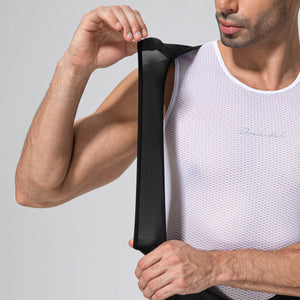
- 6 cm mesh straps
as parts of the overall fit system.
Correct sizing remains essential.
Przewalski's sizing guidance recommends prioritizing waist and hip measurements over height and weight when the measurements conflict, because waist/hip fit plays a larger role in garment compression and chamois stability. Height is more useful for judging strap tension.
→ Why does your chamois move while riding?
4. Leg Openings Should Stabilize, Not Punish
A leg gripper has a fairly simple job:
keep the shorts where they belong.
For medium-length rides, repeated small movements at the hem can gradually change tension through the garment.
But stronger is not automatically better.
The correct leg opening should:
- Stay in position
- Distribute pressure
- Avoid deep digging
- Avoid rolling
- Avoid numbness
Przewalski's Classic uses a 6 cm wide leg gripper, while its fit guidance specifically recommends reassessing sizing if the opening creates deep pressure, rolling or numbness.
5. Seams Matter More the Longer You Pedal
Consider cadence.
At only 80 rpm, a three-hour ride can involve roughly 14,400 crank revolutions.
That does not mean every pedal revolution produces harmful friction.
It simply illustrates why a tiny fit or seam issue can become increasingly noticeable during repeated movement.
The Classic uses flat four-needle, six-thread construction across its panel seams.
For a medium-length training bib, low-profile seam construction can be more useful than decorative extras.
6. Sweat Management Starts to Matter More
Two to four hours gives moisture much more time to accumulate than a short coffee ride.
This becomes especially noticeable:
- Indoors
- In humid weather
- During high-intensity training
- On climbs
- Under low-airflow conditions
The Classic currently uses a 71% nylon / 29% elastane main fabric plus a breathable back mesh, with the product page publishing moisture-management test data for the garment.
The exact comfort level will still depend on:
- Temperature
- Humidity
- Intensity
- Personal heat tolerance
The product should help manage the environment.
It cannot eliminate it.
2 Hours vs 4 Hours vs 7 Hours: Do You Need Different Bibs?
Not necessarily.
Think of these as shopping zones, not hard physiological boundaries.
| Typical Ride | Main Priority | What to Look For |
|---|---|---|
| Under 1 hour | Basic comfort | Correct fit + functional pad |
| 1–2 hours | Stability | Fit + chamois + leg opening |
| 2–4 hours | Sustained comfort | Zoned support + stability + seams + moisture management |
| 4–7 hours | Endurance specialization | Higher-density support + refined fit + storage + long-duration moisture management |
| 7H+ / events | Highly individual | Proven personal fit + endurance-specific kit + saddle/bike setup |
These are buyer-guide categories rather than medical thresholds.
Different riders can tolerate the same setup for very different lengths of time.
So Do You Need a $150 Bib for a Three-Hour Ride?
Usually, not simply because the ride lasts three hours.
That is the key distinction.
Premium bibs can absolutely offer meaningful improvements.
Current examples show how far the category can go.
Castelli Endurance 4 Bibshort
Current U.S. list price:
$175
Castelli describes it as providing endurance-level comfort and uses the brand's high-end endurance-focused pad platform.
ASSOS MILLE GT S11 EF
Current U.S. price:
$230
ASSOS positions it for daily cycling and long-distance adventures, with endurance-focused construction and a plush insert.
These are legitimate premium products.
But their existence does not create a rule that:
Three-hour ride = $175+ bib required.
The relevant question is:
Which of the premium features do you actually need?
What Are You Paying for Above $150?
Depending on the product, premium bibs may add:
More Advanced Fabrics
Lower weight, sophisticated compression, cooling textiles or highly specific stretch characteristics.
More Refined Pad Platforms
Specialized inserts, complex foam systems and advanced attachment methods.
More Sophisticated Patterning
More refined shaping for aggressive riding or long-duration stability.
Specialized Endurance Features
Premium moisture control, highly developed leg openings or reduced-bulk construction.
Brand-Specific Technology
Some of the price reflects proprietary material systems, development, manufacturing processes and premium positioning.
These can matter.
But value only exists when the rider benefits from them.
The Wrong Question: “Is a $40 Bib as Good as a $175 Bib?”
That question is too broad to be useful.
A better comparison is:
Can a well-fitted $40 bib be appropriate for a rider doing regular two-to-four-hour rides?
Yes—if that is the intended use of the product and the pad works with the rider's anatomy.
Przewalski explicitly positions the $40 Classic for up to about four hours.
The correct conclusion is therefore not:
$40 performs identically to $175.
It is:
A rider does not need to buy endurance specialization that exceeds the ride they actually do.
What Does $40 vs $75 vs $175+ Actually Change?
Using current products as examples:
| Product Tier | Example | Current Price | Published Positioning |
| Everyday | Przewalski Classic | $40 | Up to about 4H |
| Affordable endurance | Przewalski Long Distance | $75 | Up to about 7H |
| Premium endurance | Castelli Endurance 4 | $175 | Endurance-level comfort |
| Premium endurance | ASSOS MILLE GT S11 EF | $230 | Daily + long-distance endurance |
Current official pricing and positioning checked in August 2026.
This table reveals something important.
The choice is not just:
cheap vs premium.
There is a middle ground.
When Should a 2–4 Hour Rider Spend More?
There are several good reasons.
1. Your Current Chamois Does Not Match Your Anatomy
If you consistently experience discomfort despite:
- Correct sizing
- Appropriate saddle
- Reasonable bike fit
- Correct bib position
then changing pad shape or product platform can be worth far more than saving money.
2. You Ride in Extreme Heat
A heavier everyday training fabric may become less attractive in very hot conditions.
Przewalski's own Classic guidance describes the material as a more substantial multi-purpose training fabric rather than an ultralight hot-weather race fabric.
If hot-weather riding is your dominant use case, specialized lightweight construction may justify a higher budget.
3. You Ride Hard, Not Just Long
Three hours of easy Zone 2 riding and three hours of aggressive racing are not the same demand.
More performance-oriented compression, cooling and patterning may be valuable for:
- Racing
- High-intensity intervals
- Aggressive aero positions
- Repeated hard climbing
4. You Want Storage
A basic training bib may not include cargo capacity.
If you ride:
- Gravel
- Adventure routes
- Without traditional jersey pockets
then moving to a pocketed design can solve a real problem.
5. Your Rides Are Starting to Get Longer
If “three hours” has gradually become:
4H
5H
6H
full-day events
then it makes sense to move into a product actually designed around longer saddle time.
Przewalski's $75 Long Distance model, for example, is positioned up to seven hours and adds:
- Higher-density 120 kg/m³ sit-bone support
- 360 × 210 mm pad
- Four storage pockets
- Higher-compression 230 g/m² fabric
- Long-distance-specific construction.
Compare Przewalski Long Distance Cycling Bib Shorts
When Should You Stay With a $40 Everyday Bib?
If your normal riding looks like:
Tuesday
60–90 minute indoor session
Thursday
90-minute road training ride
Saturday
2.5–3.5 hour road or gravel ride
then an everyday 1–4H product is addressing the majority of your actual use.
That is exactly where the Przewalski Classic sits.
Its current $40 specification combines:
- 18 mm zoned chamois
- 90 kg/m³ higher-density support zones
- 12-panel fit
- 6 cm grippers
- 6 cm mesh straps
- Flat seams
- Indoor / road / gravel use
- Up-to-four-hour positioning.
The point is not that this specification is perfect for every rider.
It is that the product and the use case are aligned.
See the Przewalski Classic 1–4H specification
Fit Still Beats Price
There is one variable that a $200 budget cannot automatically solve:
wrong fit.
If the garment is too loose:
- Pad movement can increase
- Fabric can bunch
- Compression may be insufficient
If it is too small:
- Leg openings can dig
- Straps can pull
- Fabric can overstretch
- Chamois position can change
That is why a correctly fitted $40 bib can sometimes work better for a particular rider than an incorrectly fitted premium product.
Not because cheaper is technically superior.
Because:
fit is part of performance.
What Should a 4-Hour Bib Feel Like?
Not:
completely invisible for every person under every condition.
That is unrealistic.
A better expectation is:
The chamois stays centered
No constant pad adjustment.
The shorts do not progressively ride upward
Leg position remains predictable.
The straps do not become a distraction
Supportive without persistent digging.
No major seam hot spots develop
Repeated movement does not create obvious rubbing points.
Moisture does not overwhelm the garment
Especially indoors or in warm conditions.
You finish the ride thinking about the ride—not repeatedly fixing the shorts
That is a much more useful definition of comfort.
What If You Feel Numbness or Significant Pain?
Do not assume you simply need:
a thicker chamois.
Persistent numbness, significant pain or recurring saddle problems can involve:
- Saddle shape
- Saddle width
- Bike position
- Riding posture
- Excess pressure
- Clothing fit
Research has shown that saddle design and rider position affect pressure distribution, and cycling-related discomfort cannot be reduced to shorts alone.
A bib short is part of the system.
It is not a substitute for an appropriate saddle and bike setup.
Beginner Riders: Start With Your Real Ride Length
New cyclists often make one of two mistakes:
Mistake 1
Buy the cheapest padded shorts available.
Mistake 2
Assume serious cycling requires a $200 bib immediately.
There is a much more rational middle option.
If most early rides are:
60 minutes
90 minutes
two hours
occasionally three hours
start with a purpose-built everyday bib.
Learn:
- Your preferred pad firmness
- Your correct size
- Your preferred compression
- Your preferred leg length
- Whether you like wide grippers
- How your saddle interacts with the chamois
Then upgrade when you can identify a specific reason.
Best beginner cycling bib shorts
A Simple Decision Rule
Before buying, answer one question:
What percentage of my rides are actually longer than four hours?
Almost none
Stay focused on everyday 1–4H performance.
Occasionally
An everyday bib may still make sense; consider having one endurance option for those longer days.
Frequently
Start looking seriously at endurance-specific pads and construction.
Most rides
A long-distance product should probably become your primary bib rather than your occasional one.
This is a far better shopping framework than:
“Buy the most expensive bib you can afford.”
Our Take: 2–4 Hours Is the Value Sweet Spot
For riders whose normal sessions fall between two and four hours, the purchase decision becomes clearer once you stop treating every ride like an endurance event.
You need:
A chamois that suits your anatomy.
A garment that keeps it stable.
Leg openings that remain predictable.
Straps that maintain support.
Seams that do not become friction points.
Fabric capable of managing the environment you ride in.
You do not automatically need:
the highest price.
Current endurance products can cost $175, $230 or more. They may provide genuine advantages for the riders and conditions they target.
But if your normal riding ends around hour three, buying a product designed specifically around that everyday performance window can be a more rational use of money.
For Przewalski, that is the role of the:
$40 Men's Classic Cycling Bib Shorts.
For riders regularly pushing beyond four hours, the:
$75 Men's Long Distance Cycling Bib Shorts
become the more logical step inside the range.
The goal is not to spend less at all costs.
It is to:
pay for the performance you actually use.
Explore the Przewalski Men's Classic Cycling Bib Shorts →
Regular Price: $40
Designed around everyday road, gravel and indoor riding of up to about four hours.
Eligible new customers can also receive a one-time 10% sign-up offer through the Przewalski website registration pop-up.
Continue Reading
→ Best $40 Cycling Bib Shorts in 2026
→ Best Beginner Cycling Bib Shorts
→ Best Bib Shorts for Indoor Cycling & Zwift

