




You bought bib shorts with a thick pad.
The product page talked about cushioning.
The chamois looked impressive.
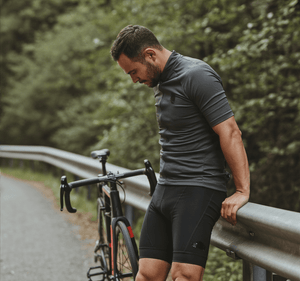
But 45 minutes into the ride, you are adjusting your shorts again.
The pad has moved.
The front feels folded.
The leg opening has crept upward.
Or the chamois no longer seems to sit where it did when you started.
At that point, many riders assume:
I need a better chamois.
Sometimes that may be true.
But very often, the more useful question is:
Why is the chamois moving in the first place?
A chamois is not supposed to work independently from the rest of the bib.
The pad, fabric, panel shape, straps, leg openings and overall fit all work together to keep it in position.
That means a more expensive pad inside a poorly fitting bib can still move.
And a thicker pad does not solve a garment that is too loose.
This is particularly important around the $40 price point.
A $40 bib may not give you every premium fabric or race-specific feature available in a $150–$250 product.
But there is one thing it should already do:
keep the chamois where it belongs.
PEARL iZUMi's current fit guidance makes the same basic point: cycling shorts should fit close and supportive without sagging, and visible wrinkles or chamois shifting can indicate that the garment is too loose.
So before blaming the foam, start with the system around it.
Why Does a Cycling Chamois Move in the First Place?
Some movement in cycling clothing is normal.
Your body is not fixed to the bicycle.
During a ride you:
sit upright,
lower your torso,
stand,
climb,
sprint,
move forward,
move backward,
and repeatedly flex the hips and knees.
The bib needs enough stretch to follow those movements.
The problem begins when the garment moves independently from your body.
You may notice:
- The chamois gradually shifts backward or forward
- One side of the pad feels different from the other
- The front of the pad folds
- Fabric wrinkles around the crotch
- The leg openings slowly climb upward
- You repeatedly pull the shorts back into position
- The chamois feels correct while standing but unstable once you pedal
Those symptoms do not automatically mean:
bad foam.
Several other causes are more likely.
The bib may simply be too large. If the fabric does not maintain enough tension around the hips and thighs, the pad has room to move. PEARL iZUMi's current buying guidance specifically says the chamois should remain centered under the sit bones as the rider pedals, while its fit guide recommends considering a smaller size if the fabric wrinkles or the chamois shifts.
The shape may not match your body. Two riders with the same height and weight can have different waist, hip, thigh and torso proportions. A nominally correct size does not guarantee that every pattern will fit every body equally well.
The leg openings may not be stabilizing the garment. The hems do more than stop the shorts from looking loose. They help maintain tension through the lower portion of the bib.
The straps may not be maintaining the correct vertical tension. Bib straps help keep the garment from dropping or shifting around the waist. But straps that are excessively loose or excessively short can both create fit problems.
The entire garment may not be shaped well for the riding position. Cycling bibs should be evaluated in a forward riding position, not only while standing upright. ASSOS notes that bibs can feel tensioned while standing and then settle into their intended fit once the rider moves into the cycling position.
The important lesson is simple:
Chamois movement is usually a garment-system problem before it is a padding-thickness problem.
Why more padding isn't always better
How Should a $40 Bib Keep the Chamois Stable?
This is where the $40 performance standard becomes useful.
A $40 bib does not need the most sophisticated pattern in professional racing.
But the basic stability system should already exist.
That system normally involves several parts working together.
Compression through the hips and thighs keeps the fabric close enough to the body that the pad does not have unnecessary room to move.
Panel construction helps shape the garment around the cyclist rather than treating the shorts like a simple tube of stretch fabric.
Leg grippers stabilize the lower edge of the shorts so repeated pedaling does not progressively pull the garment upward.
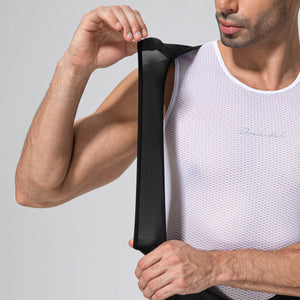
Shoulder straps maintain vertical position and reduce reliance on a waistband.
Pad attachment determines whether the chamois itself remains correctly integrated into the garment.
None of these features is exciting on its own.
But together they determine whether the rider spends two hours:
riding,
or
adjusting the shorts.
That is why stability is one of the clearest differences between:
cheap padding
and
affordable cycling performance.
How the $40 Przewalski Classic approaches stability
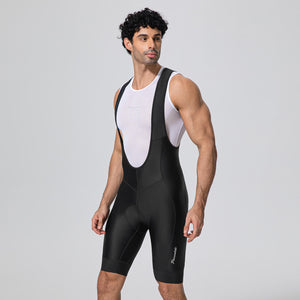
The current Przewalski Men's Classic Cycling Bib Shorts cost $40 and use several structural elements specifically intended to work together around the chamois.
The current specification includes:
- 12-panel construction
- 18 mm zoned chamois
- 6 cm breathable mesh straps
- Flat four-needle, six-thread seams
- 6 cm leg grippers
- Up-to-four-hour riding positioning.
Przewalski's current product page specifically describes the wide leg grippers as helping prevent both leg ride-up and unwanted pad movement.
The important point is not that:
6 cm is the only correct gripper width.
It is that the garment has been designed around a recognizable stability system:
PAD + PANELS + STRAPS + LEG HOLD
rather than:
PAD ONLY
That is exactly the kind of construction a consumer should already expect from a serious $40 bib.
See how the Przewalski Classic is built around chamois stability
Is Your Bib Too Loose, Too Tight, or Simply the Wrong Shape?
One of the hardest things about cycling bib fit is that riders often assume every movement problem means:
size up.
It can actually be the opposite.
A bib that is too loose is one of the most obvious reasons a chamois can move.
But making the garment excessively tight creates a different set of problems.
The goal is:
close and stable—not maximum compression.
Signs the bib may be too loose
You may see:
- Wrinkles around the hips
- Loose fabric around the chamois
- The pad moving when you change position
- Leg openings repeatedly creeping upward
- Fabric bunching in the crotch
- Frequent need to readjust the shorts
PEARL iZUMi's current guidance similarly associates wrinkles and chamois shifting with a fit that may be too loose.
Signs the bib may be too tight
Watch for:
- Leg grippers biting sharply
- Excessive strap restriction
- Fabric visibly overstretching
- Strong pulling through the crotch
- Restricted pedaling
- Numbness or persistent pressure
PEARL iZUMi recommends moving the other direction when leg grippers bite or straps feel restrictive.
ASSOS also describes correct cycling-short fit as snug against the body rather than so tight that it creates discomfort.
But there is a third possibility:
the size number may be correct, but the shape may still be wrong for you.
People have different:
torso lengths,
hip shapes,
thigh circumferences,
waist-to-hip ratios,
and riding positions.
That means:
a Medium from one brand and a Medium from another brand do not necessarily stabilize the same rider in exactly the same way.
This is also why the correct question is not:
Which brand has the tightest bib?
It is:
Which bib keeps the chamois stable without creating a new fit problem?
Can a More Expensive Bib Fix Chamois Movement?
Sometimes.
But price alone cannot fix fit.
Premium bibs may offer meaningful advantages such as:
- More sophisticated patterning
- More refined compression
- Advanced fabrics
- More complex strap systems
- Premium chamois attachment
- Highly specialized riding-position design
Those features can improve stability for the rider they are designed for.
But if you buy the wrong size:
a $200 bib can still be wrong.
If the pad shape does not match your body:
a higher price does not change your anatomy.
If your leg openings are too loose:
a premium chamois does not automatically stop the rest of the garment from moving.
That is why a useful comparison between:
$40
and
$150
should never be:
Which product has more technology?
The better question is:
Does my current problem require technology that the $40 product does not provide?
If your $40 bib:
fits correctly,
keeps the pad stable,
supports your normal ride duration,
and does not create friction or restriction,
then upgrading only because:
“the more expensive one must hold the pad better”
may not solve anything.
On the other hand, if you have already confirmed:
correct size,
correct basic position,
appropriate saddle setup,
and the bib still cannot maintain stable pad placement,
trying a different pattern or more specialized product can make sense.
The decision should come after diagnosing the problem, not before it.
This is the same value principle running through the entire $40 series:
Spend more when you can explain what the extra money is supposed to fix.
→ Do you really need a $150 bib for a 2–4 hour ride?
How to Test Chamois Stability Before You Keep a Bib
You do not need a laboratory to identify obvious stability problems.
A simple short test can tell you much more than standing in front of a mirror.
Step 1: Put the bib on correctly
Pull the garment gradually into position rather than immediately pulling hard on the straps.
Make sure:
- The chamois is centered
- The crotch is fully seated
- The thigh fabric is evenly distributed
- The leg openings sit at the same height
- The straps lie flat
Do not start judging the fit while the shorts are still twisted.
Step 2: Move into a cycling position
Lean forward as you would on the bike.
ASSOS specifically notes that the tension felt while standing can change once the rider assumes the intended cycling position.
Check whether:
- The straps feel more natural
- The chamois remains close to the body
- The crotch is not being excessively pulled upward
- The leg openings remain stable
Step 3: Pedal for a short normal ride
You do not need to make the first test your longest ride.
Use a session that is comfortably inside your normal riding ability.
Pay attention to one question:
Do I keep thinking about the shorts?
If you repeatedly need to:
pull the legs down,
move the chamois,
adjust the crotch,
or pull the bib upward,
something is not staying where it should.
Step 4: Identify what moved first
This can help diagnose the source.
Leg opening moves first
→ Check size and hem stability.
Whole bib feels loose
→ Check overall size/compression.
Straps constantly pull upward
→ Check size and torso/strap fit.
Pad moves while the garment seems stable
→ Consider pad attachment, pad shape or a different bib pattern.
Everything fits but one pressure area still feels wrong
→ That may be a pad/saddle/anatomy compatibility question rather than a movement problem.
That last distinction matters.
Not every chamois problem is a chamois-movement problem.
What Should You Expect From Pad Stability at $40?
This is the part that should change how budget bibs are judged.
Consumers often forgive basic fit problems because a product is inexpensive.
They think:
It's only $40. Maybe I just need to keep adjusting it.
That is the wrong standard.
At $40, you can reasonably accept that a product may not have:
ultralight race fabrics,
highly proprietary inserts,
extreme aero compression,
or specialized seven-hour endurance construction.
But you should not have to accept:
- Constant chamois movement
- Major fabric bunching
- Leg openings that cannot stay in position
- Straps that fail to stabilize the garment
- A fit that requires continuous adjustment
Those are not premium extras.
They are part of:
basic cycling-bib performance.
This is why the $40 category should be judged differently from generic “cheap cycling shorts.”
There are real cycling bibs in this price band.
And once the category provides:
proper chamois,
purpose-built panels,
mesh straps,
leg grippers,
and defined riding use,
the consumer should expect those components to function together.
The current Przewalski Classic illustrates that position particularly well because the $40 product explicitly publishes both its pad construction and the surrounding fit architecture rather than treating the chamois as the only feature.
That does not mean every rider will fit the Classic.
No bib pattern fits every body.
The more defensible value claim is:
At $40, Przewalski is already designing around the stability problem rather than asking the pad to solve everything by itself.
That is the standard we should expect in this price band.
Final Verdict: A $40 Bib Should Not Make You Chase the Chamois Around
If your chamois keeps moving, do not immediately buy:
a thicker pad,
a higher-density pad,
or a more expensive bib.
First check:
Fit
Is the garment too loose?
Size
Are the hips and thighs actually being stabilized?
Leg openings
Are the hems staying in place?
Straps
Are they maintaining the garment's vertical position without excessive pulling?
Panels
Does the bib shape move with your riding position?
Pad placement
Is the chamois correctly centered before you start?
Only after those questions are answered should you decide whether the pad or the product itself needs to change.
That is also where the $40 performance standard becomes very clear.
A $40 bib does not need to provide:
maximum specialization.
But it should provide:
basic stability you can trust.
The current Przewalski Classic costs $40 and combines its zoned chamois with 12-panel construction, wide breathable straps, wide leg grippers and flat seam construction, with the product positioned for everyday riding up to about four hours.
Again, those features do not guarantee that the same bib will fit every rider.
But they demonstrate the correct design philosophy:
THE CHAMOIS IS PART OF THE BIB—NOT THE WHOLE BIB.
That is what consumers should remember.
Do not judge a $40 bib only by:
how thick the pad looks.
Judge it by whether the whole garment keeps that pad doing its job.
Because if you spend the entire ride pulling the chamois back into position:
the problem isn't that you didn't spend enough money.
The problem is that the core performance is not working.
And core performance is exactly what $40 should already buy.
Explore the Przewalski Men's Classic Cycling Bib Shorts →
Regular Price: $40
Current construction includes a zoned 18 mm chamois, 12-panel fit, 6 cm breathable straps, wide leg grippers and flat four-needle/six-thread seams, with an intended ride window of up to about four hours.
New customers can get 10% off their first purchase by signing up through the Przewalski website pop-up.
Continue Reading
→Cycling Chamois Thickness & Density Explained
→Best $40 Cycling Bib Shorts in 2026
→Best Beginner Cycling Bib Shorts

